Cleopatra VII: Separating the Facts from the Myths
Cleopatra facts and myths: who the last pharaoh of Egypt really was, her intelligence and politics, and how legend reshaped the historical Cleopatra VII.
Cleopatra is one of the most famous women in history, yet much of what people “know” about her is myth. Roman propaganda, Renaissance painters, and Hollywood have all reshaped her image, often obscuring the formidable ruler underneath.
Let us separate the historical Cleopatra VII from the legend, and rediscover a queen who was far more remarkable as a politician and intellect than the seductress of popular imagination.
Who Cleopatra Really Was
Cleopatra VII was the last active ruler of the Ptolemaic Kingdom of Egypt, a dynasty descended from one of Alexander the Great’s generals. Despite ruling Egypt, the Ptolemies were of Macedonian Greek origin, and Cleopatra reigned in the 1st century BCE, long after the age of the pyramid builders.
Crucially, she was the first of her line known to have learned the Egyptian language, in addition to reportedly speaking several other tongues. She presented herself to her people as a pharaoh and as the goddess Isis, embracing Egyptian identity in a way her Greek-speaking ancestors had not.
Tip: Remember that Cleopatra lived closer in time to the invention of the smartphone than to the building of the Great Pyramid. Egyptian history is staggeringly deep.
The Mind Behind the Legend
The popular image of Cleopatra emphasizes beauty and seduction, but ancient and modern assessments point to her intelligence, charisma, and political skill as her true weapons. She was educated in the great traditions of Hellenistic learning, and contemporaries noted the charm of her conversation and the persuasiveness of her voice.
Her relationships with the Roman leaders Julius Caesar and Mark Antony were not mere romances but high-stakes political alliances. As Rome’s power grew, Cleopatra navigated a perilous landscape, using diplomacy, wealth, and strategic partnerships to preserve Egypt’s independence for as long as possible.
Much of the negative “seductress” portrayal comes from her rival Octavian, the future emperor Augustus, who waged a propaganda campaign casting her as a dangerous foreign temptress corrupting noble Romans. The victors wrote the story, and it stuck for two millennia.
Facts Versus Myths
It helps to set the record straight on some of the most persistent claims:
| Popular myth | Historical reality |
|---|---|
| She was Egyptian by blood | She was of Macedonian Greek descent |
| She was famous for her beauty | Ancient sources stress her intellect and charm |
| She died from an asp bite | The exact manner of her death is uncertain |
| She was a frivolous seductress | She was a shrewd, multilingual ruler and administrator |
| She lived in the age of the pyramids | She lived thousands of years later |
The asp story, so beloved by playwrights and painters, comes from later accounts and cannot be confirmed. What is clear is that her death marked the end of Egypt’s independence: after her, Egypt became a Roman province.
Cleopatra’s Enduring Legacy
Cleopatra’s life ended the era of the pharaohs, closing nearly three thousand years of independent Egyptian rule. Her story has been retold endlessly, by Shakespeare, by painters, and by filmmakers, each generation reimagining her to suit its own ideas.
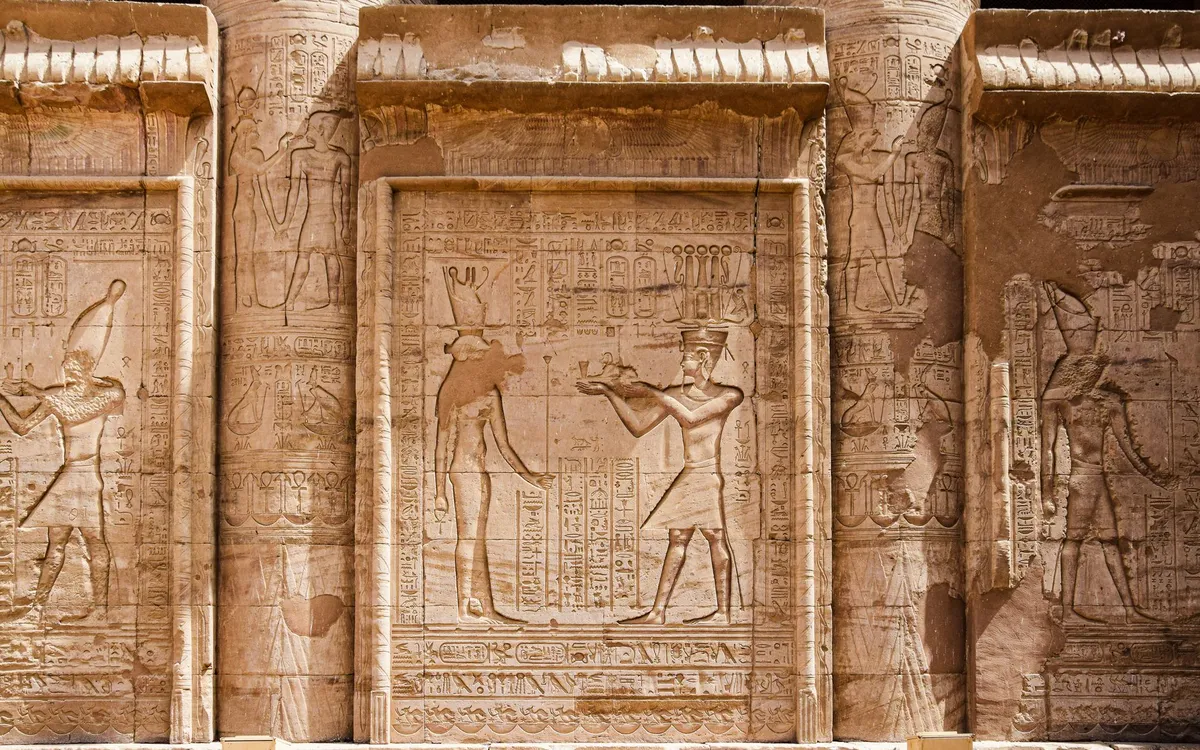
For travelers, her world survives in the city of Alexandria, the great Hellenistic capital she ruled, and in temples like Dendera, where she is depicted in classic Egyptian style alongside her son Caesarion. Walking these sites brings the real queen closer than any film ever could. You can plan your trip to explore the Egypt of Cleopatra’s age.
Conclusion
The real Cleopatra was not a one-dimensional seductress but a multilingual, politically astute monarch who fought to protect her kingdom against the rising tide of Rome. Strip away the propaganda and the romance, and you find a ruler whose intelligence and ambition more than justify her enduring fame. She deserves to be remembered for her mind, not just the myth.
Some links on EgyptInterActive are affiliate links: if you book through them we may earn a commission, at no extra cost to you. It never changes our recommendations.
Keep reading
The Curse of the Pharaohs: Fact, Fiction and the Real Story
Did a deadly curse strike those who opened Tutankhamun's tomb? Separating the legend of the pharaohs' curse from the facts.
The Book of the Dead Explained: Judgment and the Weighing of the Heart
A guidebook for the afterlife: discover the Book of the Dead, the weighing of the heart, and the goddess Maat who held the cosmos in balance.
How Mummies Were Made: Mummification Step by Step
From removing the brain to seventy days in natron salt, discover how the ancient Egyptians turned the dead into eternal mummies.