Abu Simbel from Aswan: Road, Flight or Cruise?
Reaching Abu Simbel from Aswan by predawn road trip, short flight or Lake Nasser cruise? Compare time, cost and hours on site, then pick the trip that fits.
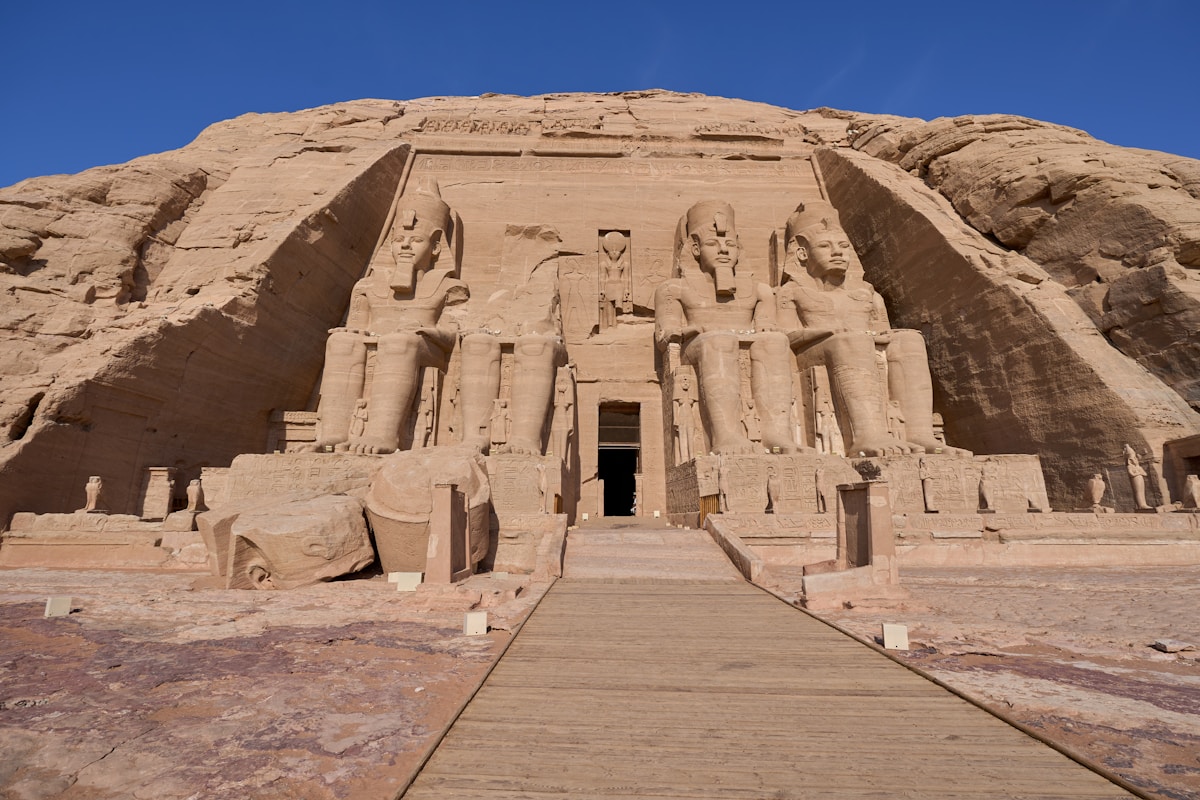
Getting to Abu Simbel from Aswan is the one Upper Egypt logistics puzzle that trips up even well-planned trips. The two great rock temples of Ramesses II sit roughly 280 kilometres southwest of Aswan, close to the Sudanese border, and there is no way to just wander over on a whim. You commit to a method: a long predawn road trip, a short flight, or a slow arrival by water on a Lake Nasser cruise. Each one buys you a very different day, and — crucially — a very different amount of time actually standing in front of the temples. This guide breaks down all three, then hands you a framework to choose.
Why Abu Simbel earns the detour
Before you weigh the how, it helps to be clear on the what, because the effort only makes sense if the payoff lands. Abu Simbel is not a single temple but two, carved directly into a sandstone cliff: the Great Temple, guarded by four colossal seated figures of Ramesses II, and the smaller neighbouring temple dedicated to his queen Nefertari and the goddess Hathor.
What makes the site doubly remarkable is that it should not be here at all. In the 1960s, as the Aswan High Dam raised the waters of Lake Nasser, the temples were cut into blocks and lifted piece by piece to higher ground in a UNESCO-led rescue. Standing in front of them, you are looking at both an ancient monument and one of the twentieth century's boldest engineering feats.
That combination is why travellers give up a full day to reach it. If you are still deciding whether it belongs on your itinerary at all, our overview of ancient Egyptian temples worth prioritising puts Abu Simbel in context alongside Karnak, Philae and the Valley of the Kings.
Option 1: The predawn road trip
The classic way to visit is by road, and it is exactly as early as its reputation suggests. Most visitors join an organised minibus or private car that leaves Aswan in the small hours — often around 4am — to cover the desert highway and arrive mid-morning. Historically the route was travelled in an escorted convoy, and many operators still bunch departures together, so an early start is the norm rather than a quirk.
The drive itself is about three to three and a half hours each way across flat, empty desert. It is long, but it is also the cheapest way to reach the temples and the most flexible on numbers — ideal for families or small groups splitting a private car.
Here is the honest ledger of the road trip:
- Lowest cost per person, especially shared in a minibus or split as a private car.
- Generous time on site — a road visit typically gives you a couple of hours to explore both temples without rushing.
- A brutal wake-up call and roughly seven hours of round-trip driving on the same day.
- Heat and monotony on the return leg, when the desert is at its hottest and you are already tired.
Who it suits: budget-conscious travellers, groups who can share a vehicle, and anyone who wants unhurried time in front of the colossi and does not mind sacrificing a night's sleep to get it.
Option 2: The short flight from Aswan
If your days in Egypt are numbered and precious, flying rewrites the maths. EgyptAir, the national carrier, runs short domestic hops between Aswan and Abu Simbel — a flight of well under an hour that replaces seven hours of driving with a fraction of the time in transit.
The catch is subtle and worth understanding: flights are built around a tight ground window. You land, a transfer runs you to the temples, and you often have only a couple of hours before the return flight — sometimes less than the road trip gives you on site. You save enormous travel time, but you do not necessarily gain more time with the monuments themselves. What you gain is your day: fly early and you can be back in Aswan by lunch, with the afternoon free.
Flying also costs more, and it inherits the usual air-travel risks — schedule changes, weather, and the discipline of an early check-in. On the plus side, the descent over Lake Nasser is a genuine highlight, giving you an aerial sense of just how much water now surrounds the rescued site.
Who it suits: time-pressed itineraries, travellers who refuse to lose a full day to driving, and anyone who would rather protect their energy for the rest of Aswan than spend it on a desert highway.
Option 3: Arrive by water on a Lake Nasser cruise
The third route is the one most day-trippers never consider: reaching Abu Simbel by boat. A separate class of vessels sails Lake Nasser between the Aswan High Dam and Abu Simbel over several nights, and these cruises approach the temples from the water — the same direction the ancient builders intended them to be seen.
This is slow travel by design. Along the way you call at lesser-known monuments that were also rescued from the rising lake, such as the temple complex at Wadi es-Sebua, sites that road and air visitors skip entirely. Many Lake Nasser boats moor within sight of Abu Simbel overnight, which unlocks the temples at dawn and dusk when the light is best and the day-trip crowds have gone.
It is the most expensive and time-intensive option, and it is a commitment of days rather than hours. But if the temples are the centrepiece of your trip rather than a box to tick, nothing else compares. For how this fits alongside the classic river itineraries, see our guide to Nile and Lake Nasser cruise options.
Who it suits: travellers with time and budget to spare, photographers chasing golden-hour light, and anyone who wants Abu Simbel as an experience rather than a stop.
Side-by-side: how the three really compare
The best choice depends entirely on which resource you are shortest on — time, money, or patience. Here is where the three genuinely diverge:
| Consideration | Road trip | Flight | Lake Nasser cruise |
|---|---|---|---|
| Total time | Full day (~7h driving) | Half a day | Several days |
| Relative cost | Lowest | Higher | Highest |
| Time on site | Generous (a couple of hours) | Tight ground window | Extended, incl. dawn/dusk |
| Comfort | Long, hot drive | Fast but rushed | Relaxed, all-inclusive |
| Extra sights | None | Aerial view of the lake | Rescued monuments en route |
| Best light | Mid-morning only | Mid-morning only | Sunrise and sunset |
| Best for | Budget & groups | Packed itineraries | The trip's centrepiece |
Notice the pattern: the road trip wins on cost and site time, the flight wins on speed, and the cruise wins on depth and light. No option is objectively best — each is best at something.
How to choose: a quick decision framework
Rather than agonise, run your trip through these questions in order and stop at the first clear answer:
- Is Abu Simbel the main reason you came to Egypt? Take the Lake Nasser cruise. Seeing the temples at sunrise from the water is a different order of experience from a hurried midday visit.
- Is your Egypt trip short and tightly packed? Fly. Losing a full day and a night's sleep to driving is a poor trade when every daylight hour counts.
- Is budget your main constraint? Take the road trip. Shared in a minibus it is comfortably the cheapest way to reach the site, and it gives you plenty of time once there.
- Are you travelling as a family or small group? A private car by road often works out well per person and lets you set your own pace on the day.
- Do you struggle with very early mornings and long drives? Fly, and spend the saved energy on the rest of Aswan and the southern Nile.
If two answers point in opposite directions, weight the one tied to your scarcest resource and commit. There is no wrong choice — only a better fit for your trip.
Timing your visit: light, heat and the Sun Festival
However you arrive, when you stand in front of the temples matters as much as how you got there. Road and air visitors almost always see Abu Simbel in mid-to-late morning, once the convoy and flight schedules deliver everyone at roughly the same time — expect company. Arrive as early as your method allows to beat both the heat and the biggest crowds.
There is one date-driven detail worth planning around. Twice a year — the events are commonly held around 22 February and 22 October — the rising sun aligns with the Great Temple's axis and reaches deep into the inner sanctuary to illuminate the seated statues. These "Sun Festival" mornings draw large crowds and require booking well ahead, so treat them as a deliberate goal rather than a happy accident.
Whenever you go, pace the wider trip sensibly: Upper Egypt's heat is real, and a day at Abu Simbel is tiring on top of everything else. Our Egypt travel tips on seasons and pacing cover how to slot this long day into an itinerary without burning out.
Frequently asked questions
Is it better to visit Abu Simbel from Aswan by road or by plane?
It depends on your scarcest resource. The road trip is cheapest and gives generous time on site but costs a full day and an early start; the flight saves most of that day but shortens your ground window. Choose road for budget and time on site, flight for speed.
How long does the road trip from Aswan to Abu Simbel take?
Roughly three to three and a half hours each way across the desert, so about seven hours of driving round trip in a single day, usually starting before dawn.
Can you stay overnight at Abu Simbel?
Yes. There is accommodation near the site, and Lake Nasser cruise boats moor nearby, which lets you see the temples at sunrise and sunset after the day-trippers have left — the main reason to consider more than a flying visit.
What is the Sun Festival at Abu Simbel?
Twice a year, on mornings commonly held around 22 February and 22 October, the sunrise aligns with the temple's axis and lights the statues in the inner sanctuary. It is a popular, crowded event that needs planning and advance booking.
However you reach it, the goal is to arrive with the energy to actually take Abu Simbel in. Match the journey to whether you are short on time, money or patience, book ahead in the busy season, and let the trip serve the temples rather than the other way around.